
The NTT Group and JERA Cross Complete a Demonstration of Hourly Matching Aimed at 24/7 Carbon-Free Power Supply: Japan’s First Demonstration of Hourly Matching Using Biomass Power Generation
NTT Anode Energy Corporation (“NTT Anode Energy”), JERA Cross Corporation (“JERA Cross”), and NTT Docomo, Inc. (“Docomo”) conducted demonstration testing of hourly matching2 in electricity supply and demand from December 2024 through September 2025, aiming to provide 24/7 carbon-free power1 to Docomo’s communications buildings.
NTT Anode Energy has been supplying electricity to Docomo’s communications buildings through a mix of non-FIT solar power4 with additionality3 and biomass power5,6 in Japan’s first demonstration testing of hourly matching using biomass power generation.*7
In recent years, adoption of renewable energy has accelerated worldwide as part of efforts to address climate change. Amid this trend, “24/7 carbon-free power,” which aims to supply carbon-free electricity twenty-four hours a day, 365 days a year, has drawn increasing attention.
In addition, as part of revisions to the GHG Protocol, the international standard for calculating and reporting greenhouse gas (GHG) emissions, the establishment of new criteria related to 24/7 carbon-free power is being considered. This is expected to significantly impact how companies pursue sustainable energy use. 24/7 carbon-free power supply requires achieving the following two things:
Establishing information collection and reporting methods to objectively demonstrate 24/7 demand–supply matching
Improving technical and institutional mechanisms for matching renewable electricity generation with demand-side electricity consumption
The demonstration, aimed at achieving (1), applied JERA Cross’s technology at three Docomo communications building sites to which NTT Anode Energy supplies electricity (Docomo Aomori Building, Docomo Akita Building, and Docomo Sendai Building). Electricity consumption and generation were tracked on an hourly basis to confirm demand–supply matching.
Hourly Matching Results
Using the platform of Granular Energy,8 a JERA Cross partner, the parties achieved hourly matching that complied with the international standard for hourly matching of electricity consumption and generation (the Energy Tag Standard). The Energy Tag Standard is an international standard established by the international non-profit organization Energy Tag9 to accurately link renewable electricity generation and electricity consumption on an hourly basis. Conforming to this standard enables companies to transparently demonstrate which hours of electricity consumption were covered by renewable electricity generated during the same time period. It enables more precise and reliable proof of energy usage than conventional evaluation based on annual totals and is an important metric for advancing corporate decarbonization efforts and reinforcing accountability to overseas stakeholders.
Using Granular Energy’s platform, it was possible to visualize, by month and by hour, the degree to which electricity from solar power (yellow bars in charts) and biomass power (green bars in charts) matched Docomo’s electricity consumption (navy lines in charts). Because time periods with shortages and surpluses of renewable energy can be intuitively identified, the platform can also be used to improve renewable energy procurement and power operations.
In addition, graphed areas where consumption and power generated by each source did not match (gray hatched bars in charts) correspond to periods when biomass power generation was suspended due to periodic inspections and power was supplied from other sources. This shows that achieving a 100% hourly matching rate requires securing backup renewable energy sources in preparation for generation stoppages caused by periodic inspections or unexpected trouble. Conversely, for months and hours where electricity consumption and power generated by each source did fully match, electricity consumption was entirely covered by renewable electricity, achieving a 100% hourly matching rate.
Monthly Matching Results During the Demonstration Period

Monthly matching results during the demonstration period
Hourly Matching Results During the Demonstration Period (Average)
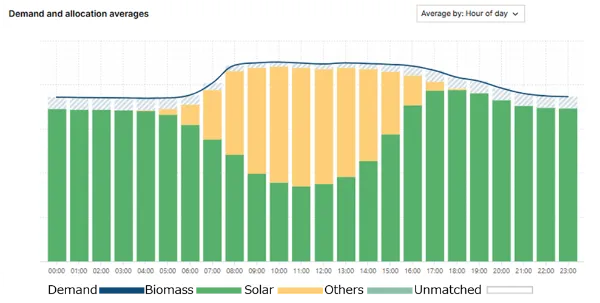
Hourly matching results during the demonstration period (average)
Matching Results for June 2025 (100% Achieved for All Hours)

Matching results for June 2025 (100% achieved for all hours)
Going forward, NTT Anode Energy and JERA Cross will work with customers including Docomo to enhance technologies and develop institutional mechanisms for matching renewable energy generation with demand-side electricity consumption, including through the utilization of battery storage facilities. They will strive to respond to the needs of society and customers while contributing to the realization of carbon neutrality across society.
As an electricity customer, Docomo will proactively pursue the use of renewable energy and the promotion of carbon neutrality. In collaboration with related companies, Docomo will contribute to the realization of a decarbonized society.
Notes
*1 “24/7 carbon-free power” is a name for electricity that emits no CO₂ twenty-four hours a day, seven days a week, 365 days a year. In accordance with the Ministry of Economy, Trade, and Industry’s “Guidelines for Retail Sales of Electricity,” this means that 100% of electricity demand is met with electricity generated through a mix of zero-CO₂-emission sources (renewable energy generation facilities and hydrogen power generation facilities) combined with the environmental value derived from the use of non-fossil certificates; it does not mean that no CO₂ is emitted across the fuel lifecycle including production and transportation.
*2 Hourly matching is an initiative to match electricity consumption and the supply of renewable energy on an hourly basis.
*3 Additionality means contributing to an increase in new renewable energy facilities and is regarded as important for companies that actively seek to procure renewable energy.
*4 Non-FIT solar power generation means solar power generation that does not use the Feed-in Tariff (FIT) scheme.
*5 “Introducing More than 22 GWh per year of Solar and Biomass Power to Docomo Buildings in the Tohoku, Hokuriku, and Kanto Areas” (Docomo announcement, 26 April 2024).
*6 This electricity is supplied by ENNET Corporation (Retail Electricity Business Registration No.: A0009), part of the NTT Anode Energy Group, with NTT Anode Energy serving as an intermediary.
*7 As of 28 January 2026, there have been no publicly disclosed cases in Japan of hourly matching reports that utilize biomass and solar power sources and achieve 100% for all hours. (Based on research by NTT Anode Energy and JERA Cross.)
*8 Granular Energy is a French startup co-founded in 2021 by Dr. Toby Ferenczi, the founder of Energy Tag, an independent non-profit standardization body. The company is a leading provider of solutions that enhance energy transparency, including early examples of 24/7 carbon-free power.
*9 Energy Tag is an international non-profit organization that establishes international standards for granular certificates (GC) to optimize the use of renewable energy and create a transparent energy market.
About NTT Anode Energy
NTT Anode Energy, aiming to achieve a decarbonized society and to promote the local production and consumption of energy, provides next-generation energy solutions that leverage NTT Group technologies and assets. Through an energy distribution platform that provides advanced control of distributed resources such as renewable energy and storage batteries, the company actively pursues demand response, supply–demand optimization, and battery storage businesses.
Corporate website: Top | NTT Anode Energy (https://www.ntt-ae.co.jp/)
About Docomo
Docomo provides services including mobile communications and “smart life” businesses. As part of its environmental initiatives, Docomo has set the goals of achieving “carbon neutrality” (net-zero greenhouse gas emissions from its own business activities) by 2030 and “net zero” (net zero emissions across its entire supply chain) by 2040. Under these goals, Docomo aims to become a leading environmental company and is actively advancing initiatives such as the adoption of renewable energy and deployment of solar-powered green base stations.
Corporate website: Top | NTT Docomo (https://www.docomo.ne.jp/)
View All News

JERA Group Information Security Basic Policy
List of registered retail electricity providersList of Specified Wholesale Supply Business EntitiesLegal Notice under the Act on Specified Commercial TransactionsList of non-fossil value trading providers